“Eyes I dare not meet in dreams in death’s dream kingdom”
-The Hollow Men, T. S. Eliot
“Christ, Max, it’s the first day of school,” Elisa grumbles. We’ve gone to one of the hallway windows on her floor, since it’s late and we don’t want to go all the way down to the common area. “How have you already fallen in love?”
My hands shoot up in a mixture of self-defense and revulsion. “Love is a strong word. I just can’t get it off my mind is all, and I don’t wanna stay up all night thinking about some chance first-day encounter.”
“You mean you can’t get him off your mind,” she raises a tired eyebrow. “Either way, it’s too early to be having schoolboy crushes. You don’t even know the guy’s name.”
She’s right. I feel disgusted with myself.
“Oh, wow, I didn’t even know you could turn that shade of red—you’re so pale all the time,” Elisa teases. “Here, why don’t you just listen to a bunch of sad songs and just try to go to bed? This is definitely a blip, and you’re just experiencing some tiny jump-the-gun jitters. It’ll pass. Just don’t worry about it, okay?”
I nod and wring my hands together as my right leg starts to quiver a bit. “You’re right, probably.”
My friend scoffs. “What else is new? Now, I need my beauty rest, and you look like you do as well. We won’t want frown lines, so we’re going to go to bed now.”
“Okay, thanks again,” I rise slowly, crossing my fingers that I’ll find some comfort.
“Don’t worry about it.”
We’ll see how that goes.
Long story short, I end up getting a decent amount of rest both that night and the following, although I do venture down a pretty loopy rabbit hole on day two while drafting my Bradstreet analysis. That means, of course, that I spent the majority of my day working on it, as my two classes—Foundations of Sociological Analysis and an intriguing survey called Lyric and Verse in Context—had concluded not long after noon. Nonetheless, I’m fully rested and prepared with a sizable filled portion of one of my notebooks for Dr. Quin’s discussion when it comes time on day three. Color coordinated, of course.
I decide to leave my leisure books at home. As much as I admire Quin, I don’t want another embarrassing interrogation. I continue my routine of grabbing a coffee before first period, but I decide that I’m going to try something new as I’m stepping through the doorway.
Lending a half-second’s glance to the options, I decide to take the bold step and try an americano. Maybe it’ll be a good luck wake-up before Quin’s Bradstreet discussion. I’m already jittery even without the caffeine—I can feel my left leg twitching as I stand by the counter. Luckily, an all-too-familiar, unbothered drawl brings me out of my anxious fit.
“You ready?”
My head turns so quickly that I fear I may have trouble sleeping tonight. It comes at both little and extreme surprise that the Boy happens to also be waiting for his order. He isn’t fully alert, and his eyelids droop ever so much more slightly than yesterday, but his crystalline irises still attract my gaze. Today, his eyes are complimented by a simple white tee and a mundane pair of cargo shorts. It gives him a boyish air, but something about it emanates a leisurely maturity as well.
“For the discussion…?” he adds slowly. I can almost picture the vacancy on my face.
“Yeah, I got that,” my mouth forms before I can think.
The Boy’s left eyebrow ticks upward for the briefest of moments before resettling in its original drowsy state. “Well, I guess I should’ve supposed the answer. Those notes from yesterday are too pretty for you not to be diligent.”
Before I can respond, a barista with braids interwoven with green comes up to the counter, examining a cup label and reading, “Julian?”
“That’s me,” the Boy mutters. Addressing me, he says, “Guess I’ll see you later, then. Excited to see what you can do.”
Grabbing his drink, he saunters away, brushing mere inches past me as he departs. My train of thought has exited stage right. It takes a couple of tries before the barista can get my attention to let me know that my order it ready.
My mental blankness continues, unfortunately, straight into Stats. My hands move independently of my mind, rigidly copying down the numbers that Dr. Suzuki commits to the board, but my mind fails to form tabulations of its own. It’s too trapped in an interminable mental circle, repeating the Boy’s—no, Julian’s—generous compliments. Sadly, my foolish response to Julian’s question also imprisons my thoughts in an embarrassing cycle.
Yeah, I got that. What a dumb thing to say.
“…really lost in thought, huh?” I hear a loosely-recognizable voice ask after an indeterminate amount of time has passed. I’m sitting across from Elisa on a cafe bench, though I’ve forgotten how we got here. I’ve truly lost myself. If Elisa’s right and this is what love is, I’m not too sure I’m a fan.
“Never mind, then. I have my answer,” my friend shakes her head, amused.
It’s not until Quin’s class that I finally wake up—and only out of immense need. I sit in the same seat as I did on day one, with my back to the table. As my classmates flood into the room, a sense of familiarity settles into the room. Putting my things in their proper places in front of me, I finally feel at ease. Even so, I can’t help but feel a little uneasy when Julian takes the seat next to me again.
“Howdy,” he chirps. The light on his back shades his face, making his eyes look darkened with hues of green.
Thankfully, my synapses don’t fail me, and I’m able to get out, “It’s Julian, right?”
His head dips and the corners of his mouth tick every so slightly upward into a cheeky little smile as he confirms, “That’s my name. I don’t think I got yours.”
“Alright then,” Dr. Quin’s voice booms before I get the chance to respond. “Looks like some of you are ready to jump right in, and from where I’m standing, it looks like this assignment proved pretty easy.”
I give an awkward little side-glance at Julian, hoping to convey some sense of apology. He waves his hand dismissively.
Quin continues, “This afternoon, we’re going to be doing some group talk on the two poems I assigned. If time permits, we may do a little bit of sharing with the entire class. My hope, of course, is that you guys have Googled enough to fill up the whole class time with discussion.”
“It looks like you’ve all chosen the same seats as our introductory class, so I’d recommend getting in groups of three or four. Oh, and I beg of you all, don’t get too loud. Sound travels well in this room, and I’m going to at least attempt to follow your conversations. Disagreements will be settled with a coin toss, or joust, or something civilized. That’s all from me. Three-two-one-go,” our professor concludes speedily.
Everyone slowly arranges themselves into small clusters. Julian and I end up in the same group due to proximity, of course. With the addition of a short girl to Julian’s immediate right with soft brown skin and glossy, braided hair, our group is complete.
Out of the three of us, my notes stand out. Julian has his notes organized linearly in his notebook, and they’re written in pencil, in a slanted and stiff script. The girl’s, meanwhile, are written in lavender, seemingly using the same pen that she’s made doodles in the top corner of her notebook with.
The girl starts speaking first. For several minutes, she talks about how in “Prologue,” Bradstreet insinuates that men are naturally gifted by the Muses to write historically famed poetry, while she presents men as incompetent in other walks of life in “The Four Monarchies.” Everything she says is almost taken straight from my mouth.
Julian agrees. They go back and forth for a little while talking about the ways in which Bradstreet presents men, whether it was as idol worshipers in the case of Belus or human-sacrificing oppressors like Ninus.
I don’t insert myself into the conversation, simply jotting down what my partners say, until Julian turns to me and entreats, “What about you, mystery man?”
My mind blanks, and what comes out of my mouth is, “Oh… yeah, you guys pretty much said it all.”
Julian’s right eyebrow deviates from its usual languid state. He leans back, lounging in his seat, almost in deference, and supposes, “I saw those stunning paragraphs of yours when you opened your notebook at the start of class. There must be more than what we’ve already said resting in your brain. So… wow us.”
Subconsciously, my right leg jerks lightly, and a mild tremble starts to form. Obliging, I nervously start saying, “I think it’s sort of cool… the stance that Bradstreet adopts in ‘Prologue.’ It kind of seems like she’s putting on a ‘pick-me’ mask.”
“Not to suppose anything bad about Bradstreet, though,” I stumble, rubbing the back of my neck to ease the rising heat. Nevertheless, I continue, “It’s sort of psychological—or at least, to me—uh, it’s like she’s being too humble almost. And it worked for me. I don’t know about you both. I digress. It’s just- she keeps playing her poetry down, you know, like ‘obscure lines,’ and…”
I trail off, distracted by the tapping noise coming from Julian shaking his pencil right above the table. Every so often, the tip or the eraser will come in contact with the table’s surface, producing a shrill clacking noise. A second passes before he stops, apparently accounting for my sudden attentiveness to the noise.
“And…?” he prompts with an almost-smile.
“Uh, sorry,” I rush to say. “And… oh, and, her poetry isn’t actually bad. She seems like she’s annoying—not annoying—well, pestering, or, self-deprecating, so much that you just have to read her poetry in order to… to satisfy her self-pity or maybe to prove her wrong. I don’t know, that’s just me. Maybe she really means what she said. That’s just how I looked at it.”
The girl giggles briefly, a sharp noise. “You’re so right, actually. Anne really is a crafty one. I like that take!”
Julian looks down at his notebook and etches a few words then looks up gives me an approving glance. Imbued with newfound confidence, I ramble out a few more minutiae that I had spotted—her references to the Europeans, her constant repetition of the word “Muse,” her technical work in the final stanza.
Both of my partners give quality inputs. It feels like the first time that I’ve spoken my mind about poetry, ever. Needless to say, the masterful discussion makes the hour go by quickly, and Quin’s suggestion for a possible whole-class summary ends up unfulfilled.
“I hope you liked today’s conversations. If you didn’t, that sucks for you, because we’ll be doing this again the next time we meet! Read ‘Contemplations.’ I posted it. See you all next time. Leave!” With that, Quin dismisses us.
“I knew you wouldn’t disappoint,” Julian sighs happily. “Well, ‘til next time, mystery man. Literally can’t wait.”
He takes slow strides out of the room. I might just be imagining it, but from where I’m sitting, it looks like the briefest of grins flashes upon his face as he steps out of the doorway. I stare at the space where his back disappeared behind the wall.
A tap on my shoulder attracts my attention back to the moment. It’s the girl.
“Would you mind sending me the stuff you wrote down in class today? I noticed you were pretty busy doing that,” she requests. “Your notes are so pretty, by the way. I love the different colors. They just all fit together.”
I beam. “I love the colors, too! Also, I would not mind.”
I enter my phone number into the girl’s phone. She thanks me, saying “I’m Safiya, by the way. What’s your name?”
“Max,” I answer.
“Cool. Alright, then, I’ll be in touch!” Safiya smiles sweetly.
I’m still packing by the time she dashes out of the classroom. My brain runs over everything I’d said in class as I leave the building, double and triple checking for any social errors I may have made. I almost smack myself upon the reminder that I never gave Julian my name.
I have a nickname now, though, a pesky voice in the back of my mind pipes up. So, maybe it’s not such a bad thing…
***
My dream that night is more vivid than my subconscious is normally able to conjure.
It’s a memory. One of when my brothers were still living with my mother and I. I thought I had forgotten it, but here it was, resurfacing, an effect only attributable to the emotional joyride my heart had gone on during the day. In the memory, my mother had driven my brothers and I all the way down to Texas on a road trip so that we could admire the view of the sky at night in Big Bend. I remember now how I grumbled all the way down, how I kept my brothers up all night in the hotel because I couldn’t fall asleep—a common occurrence. Perhaps that’s why they jumped at the opportunity to venture to the Netherlands.
I stand next to my brothers in the memory. My mother should be there, but for some reason I can’t feel her presence. I try to turn around or even stand up to find her, but my gaze is fixed on the starry sky above. I can barely make out my brothers’ figures in my periphery.
I start to develop the idea that maybe I’m dreaming. A comet darts across the sky, leaving a trail of shining dust in its wake. Two more follow it shortly after, their tails tracing out patterns along with the first’s. This is not part of my original memory.
A muffled voice erupts from my right, asking, “What do you think it’s going to be like when we’re married? Are you guys going to throw flowers on the ground during my wedding or something?”
The lack of enunciation lets me know that it’s Casper.
Christian’s higher-pitched yet also muffled voice responds, “That’s a job for flower girls, dummy. We’re gonna be standing next to you and wearing suits. Duh.”
“Oh, right,” Casper intones distantly. “I wonder what kind of woman I’ll marry. I hope she’s pretty and has straight hair like Mom. Maybe she’ll have glasses like Max or maybe she’ll have curly hair like you, Christian.”
“That’s weird to think about,” responds Christian plainly.
“What d’you mean?” asks Casper. “You never think about the girl you’re gonna marry? What about you, little brother?”
At seven, I don’t have the heart to tell him that I don’t think about girls. I keep my mouth shut, staring at the stars pulsate in and out in the sky above. The twins continue their naive conversation, but their voices recede into the distance. In the corner of my eye, I see their tiny outlines fade and become nothing. Suddenly, I’m all alone, my head locked in this upward-facing position, watching as different lights peek out of the blue. All of a sudden, a chilly glow envelops my vision. One glimmer stands out from the rest of the boring white, bathing the entire scene with an icy light. The hue looks so familiar. It’s so startling, like a glint on the surface of the ocean, yet it’s also comforting, like a cold-induced drowsiness that makes your eyelids contract a little. The light is so far away that I can’t recognize it, but I know that I’ve seen it before. I try harder and harder to recognize it, racking my memories for any signs, but the color eludes me. The more I think about it, the fainter the light gets until it snuffs out completely.
I wake to complete darkness with a jolt. I can barely remember what happened in my dream. All I see when I close my eyes again is that faint glimmer of turquoise. With my eyes closed, another pair opens. Julian’s, in that shade of blue. My heart sinks. I’ve done it again.
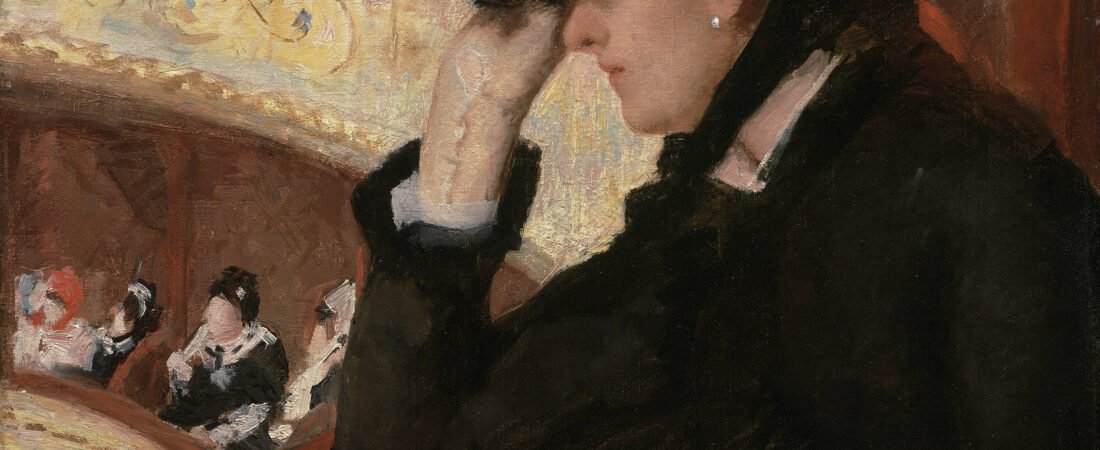
Above painting: At the Opera by Mary Cassatt